
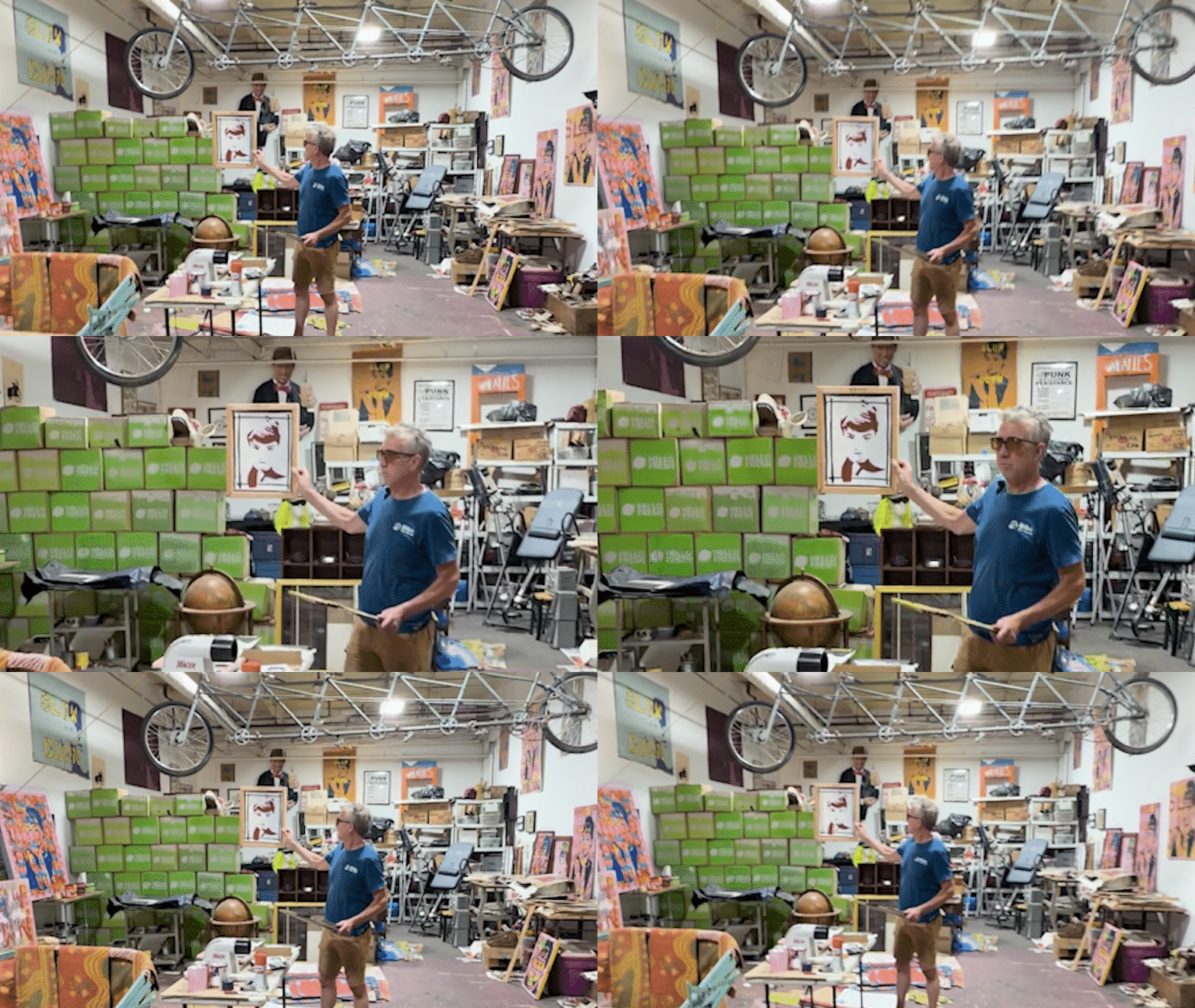
Artist Matthew Feiner in his New Haven studio
“Slow Down” signs are four leaf clovers in New Haven. They’re hidden throughout our city: on boarded up street corners, hung below “no parking” signs, painted on roadways, sprinkled along our periphery.
But since our last interview with Matthew Feiner four years ago, they’ve become less of a rare floral mutation and more of a permanent and beloved part of New Haven. In 2024, Feiner stopped counting how many Slow Down signs he had put up when he reached 435 signs. He continues pasting them up and fixing ones that have lived past their prime.
In our almost half-decade reunion, the founder of The Devil’s Gear shares what keeps him displaying these signs to the community, signs that go beyond driving and into how we interact with ourselves and one another.
How do you introduce yourself?
Just Matthew Feiner. I'm really awkward now. I used to be very comfortable with people in the public and whatnot, but since the brain injury, it changed how I perceive things and meet people and re-meet people.
How long ago was the brain injury?
It's going to be ten years, but it was a succession of injuries. I got a brain injury in a bicycle crash. And then I went into a burning building a year later to get somebody out, and a propane canister exploded behind my head, gave me another injury.
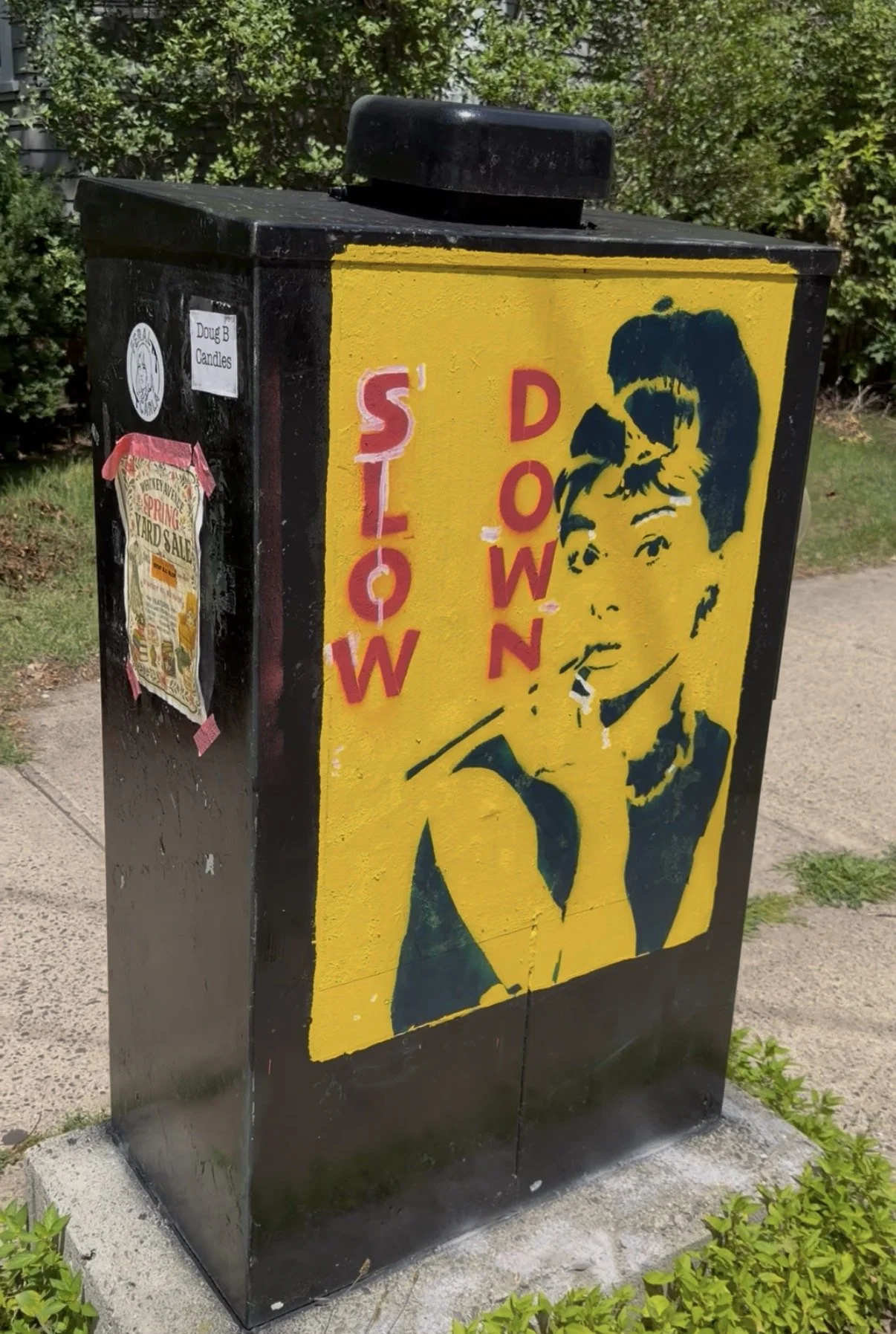
Slow Down mural painted by Matthew Feiner on Orange Street in New Haven, CT.
I had a seizure in Hamden. [My girlfriend] Tracy called 911 and the fire department came in and didn't like the way I was behaving. Piled six cops on top of me and broke my neck. It feels like yesterday. It was five, six years ago now. Broke my neck, broke both my shoulders. Tore both my biceps off of my arm. I broke my ankle, my wrist, and then didn't tell the emergency room that I was injured. So for a year I complained about all these injuries and the hospital was like, you came in with nothing. And I was like, you didn't test me for anything. So I've had five surgeries since then. But I'm okay. I go out into the world. And sometimes the people I'm burning in front of somebody, and I'm just like, wow, you don't see that I'm on fire right now. And it's different. Now I understand.
Why “slow down?”
My horoscope told me to do it. It said, “you need to slow down.” And then it said it again, and then again and again. It was metaphorical. It was spiritual. It was physical. It was across the universe. So I started to write it down, “slow down.” I would write notes to myself, “slow down” on yellow pieces of paper, slow down, slow down. And then a friend of mine got it tattooed on his hand. He was like, oh, look, slow down on his right hand. Just a constant reminder.
It really had to do with the anxiety. I was rushing because of the anxiety I was experiencing. I couldn't do anything fast enough. So then I started putting up the slow down signs on the road, it just said slow down. But then by accident, I combined the Audrey stencil and the slow down because I'd thrown one on top of the other and one in the other.
Then when I lifted it up, there it was. It was just her face looking out through the slow down. And it was just perfect. And so I combined the two of them.
But it was really my horoscope driving it forward. Real Astrology.
What's your sign?
I'm a Sagitarrius with Gemini Rising, and I've been reading this fella, Rob Brezsny, since I lived in Austin back in ‘92. I find that when I'm living my life true to myself, that my horoscope is very accurate. And I don't read it every day. It's been pretty interesting in my life how things happen out of my horoscope, and I'm sure other people can say that too.
25 years ago, it told me I was going to find a wooden cross as a sign of my freedom, that I was done with all my battles and I was being offered the wooden sword. Two days later, I found a wooden sword on the ground at a house I was helping paint.
You’ve been kind of creating those wooden signs for other people to see. Why did you want to share the message to slow down?
Cars are speeding. It’s got out of hand. They killed Stephen, a dear friend of mine from the bike shop we called Mr. Spritz. He worked at Yale. He got hit on campus and killed while riding his bicycle. And this was one of the nicest people in the world. And when that happened, I really kind of stepped up the program.
It was a way to deal with that. He was really something, he was a good guy. He was just always so kind. And people are speeding. But people are also distracted. We're also trying to process so much information right now that's coming at us, that we're all in a bit of a rush.
America was raised on convenience. Now time is inconvenient and people are rushing because they can't fit. They can't fit into their day what they used to normally do because of all these things that they've added on out of a quest for something else.
We need to slow down as a culture. We need to think more. We need to really take into consideration everything, not just ourselves and if we're late.
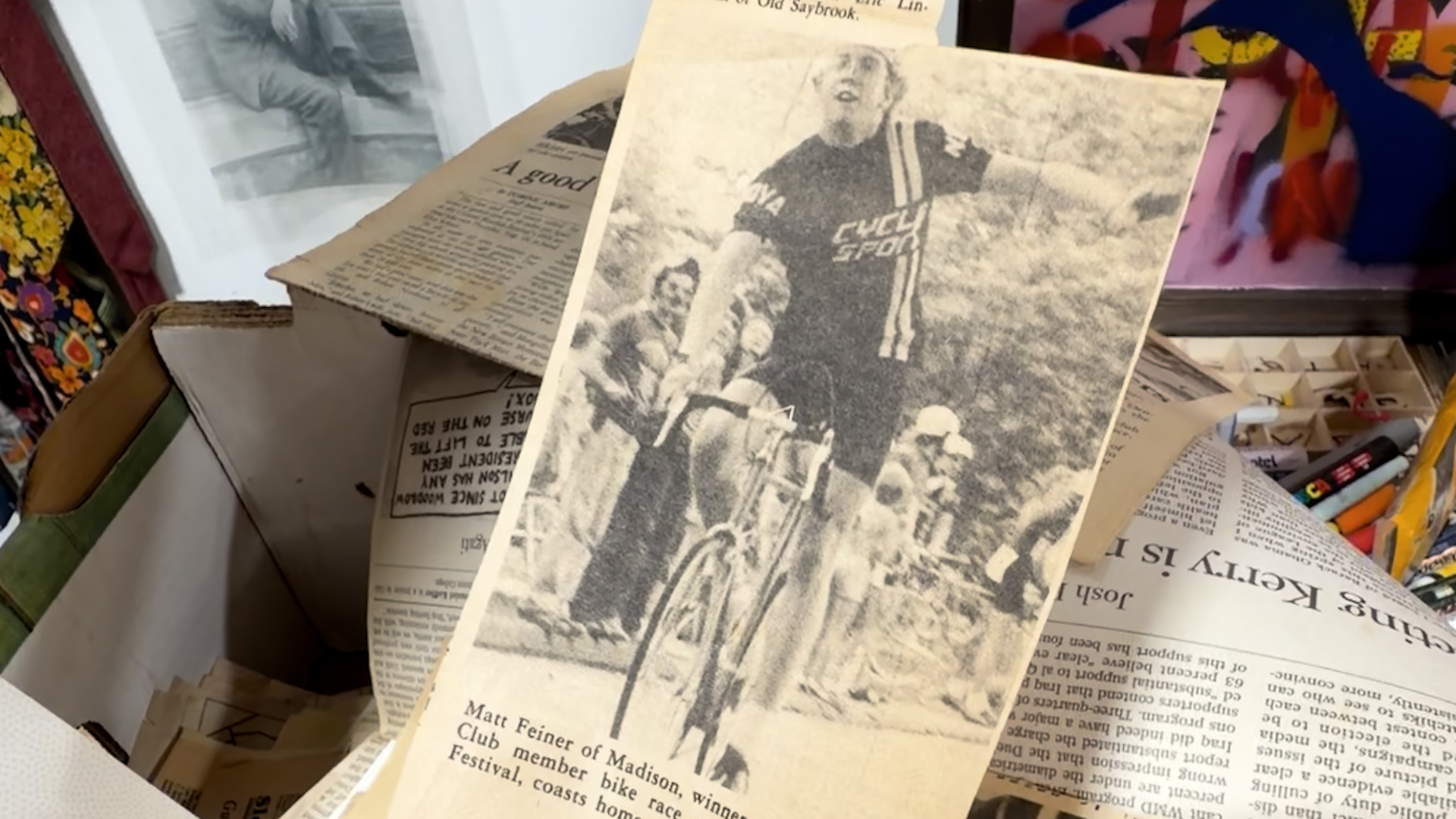
Matthew Feiner in road race as a teen.
When did you start biking?
I've been biking my whole life. I had a shattered leg when I was a kid, so I had a hard time walking and running. So bicycling to me became really, really important at an early age, like I was racing by the time I was 13.
I won my first five bicycle races as a junior racer. I just took to it and continued to ride and race my whole life. But it wasn't until I moved back here [in New Haven] that I really wanted to make bicycling better for everyone.
When I moved back here 25, 26 years ago, I got made fun of for riding my bicycle to work in the rain, and I worked at a bicycle shop. I showed up on the first rainy day of me working there, and everybody was like, “What are you doing?” I was like, “What do you mean, what am I doing?” I was taking off my raincoat. “Do you have a car?” I was like, “No, I don't have a car. I have a bicycle. I'm a commuter.” So when I left that bicycle shop and started the Devil's Gear with $600, people asked me what I was going to do.
I was like, “I'm just going to do bicycle repairs and advocacy.” And they're like, “What's the advocacy?” Then we formed Elm City Cycling – me, Melinda Tuhus, Rob Rocke, Bill Kurtz, Elaine Lewinnek, a handful of really great creative people.
We started a New Haven Critical Mass, but we called it the Kind or Less Critical Mass because we didn't want to do what they were doing in other cities, which was very combative and militant, and we were trying to do something different. So we made a lot of signs that said, honk if you like bikes. You know, we played the other hand and it took a couple months of working with the city before they stopped sending the police down on top of us. We were considered bad people. We had motorcycle police wanting to shut it down and then wanting to escort us and then wanting nothing to do with us. So it was pretty weird.
In the summer of 2004, I went toe to toe with a New Haven motorcycle cop because he was telling us to get off the road and whatnot, and yelling at me directly. And I said, you know, I'm defending my friends right now. He took a step forward and I took a step forward.
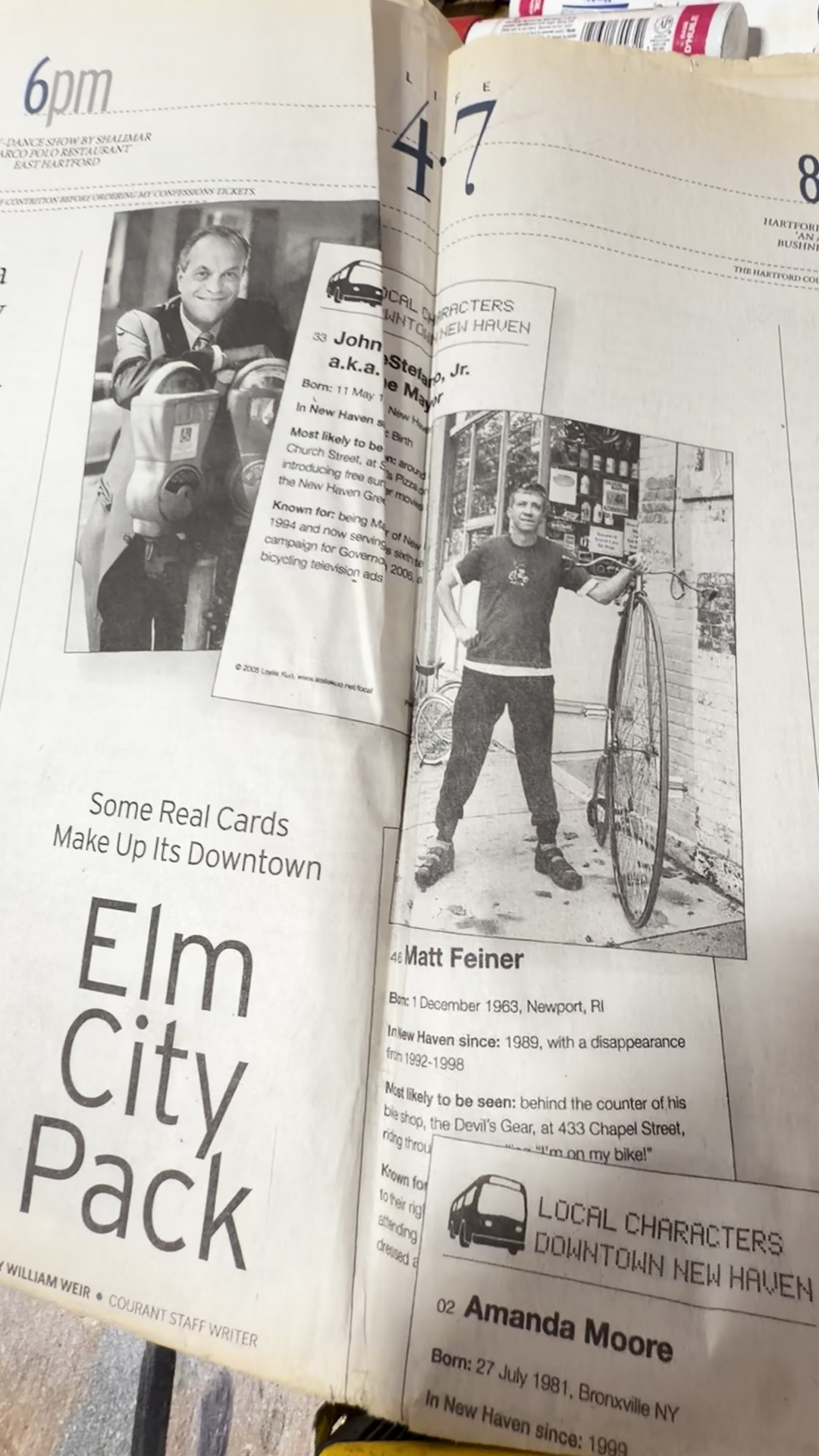
Matthew Feiner featured in The New Haven Register in the 90’s.
And he goes all right, Sergeant Ray has it there. He's New Haven's storm trooper. He was in the movie, Return of the Jedi.
New Haven has become a biking city, but I know so many people who have gotten into accidents and got concussions.
Oh, all the time. There is a lot of bad infrastructure, but right around somewhere around Covid, communication about the laws I think fell off. Now, I see a lot more people on bicycles riding poorly. Just disrespecting the laws. I think it's a cyclists responsibility to demonstrate the law, because then you don't get to keep the street.
What are some examples of that?
Not stopping at red lights, not stopping and not slowing for stop signs, riding the wrong way on streets. There really is a set amount of laws and etiquette. Biking becomes safer when you follow them. You have to be predictable on a bicycle because you're not surrounded by a ton of steel. You're silent as the bike rider. So the people walking don't hear you until you startle them. When you go by, you're supposed to call out, ring out. You're supposed to have an audible device on your bicycle. That's the law. Bell, horn, or your voice.
And a lot of people don't use them. When you start adding speed to that in a group ride, calling out your pass is paramount.
When was the first year you started putting up Slow Down signs?
Four years ago.
And how many have you put up?
I lost count.
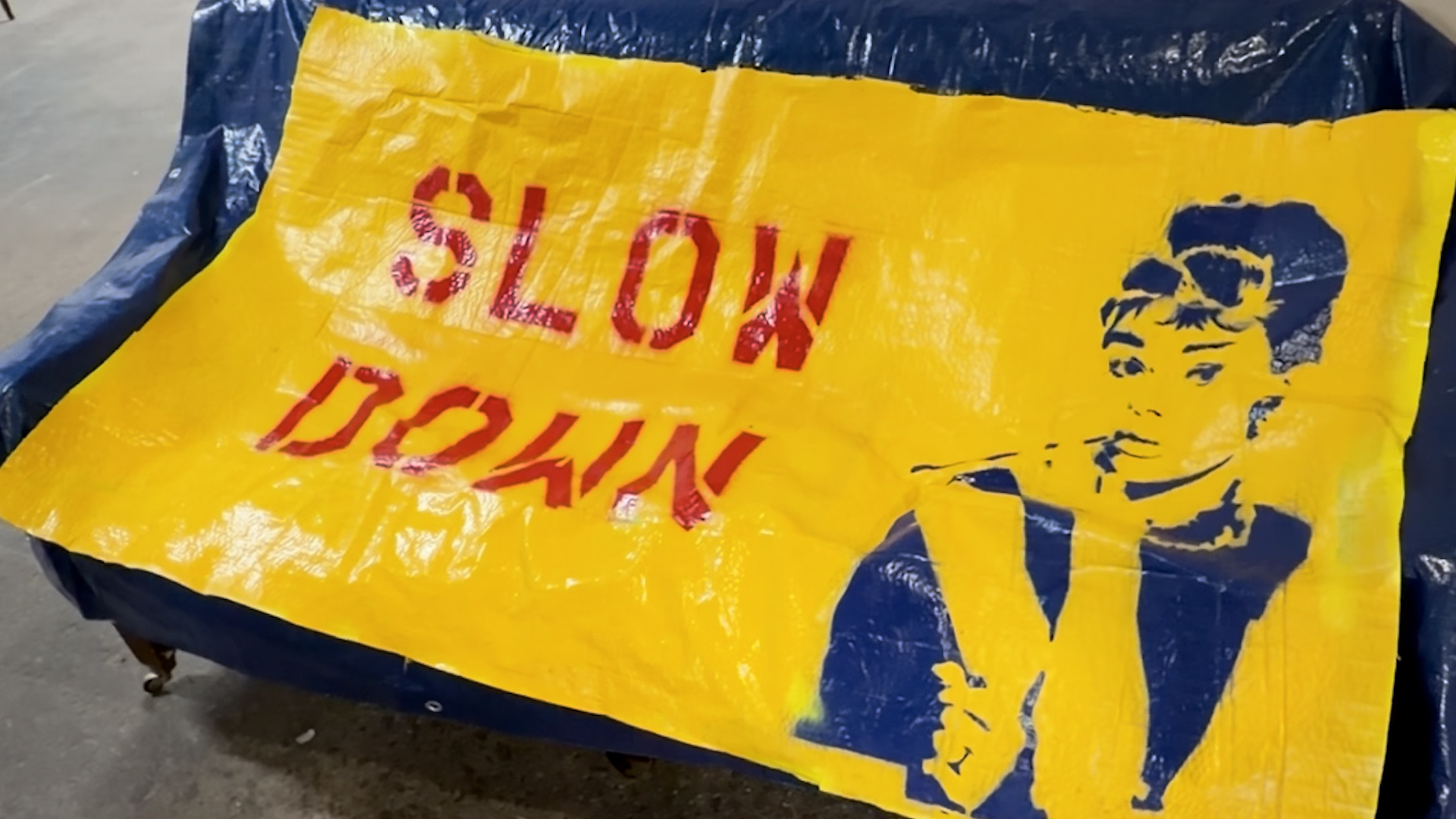
Slow Down sign being mended by Matthew Feiner in his studio.
When was the last time you were counting?
Two years ago, I counted 435.
What motivates you to keep putting up these signs?
Anger. Anger issues. I get mad, I get angry. So this is how I vent that anger. This is how I've met that sadness. I've lost too many friends to bicycle accidents. And everybody in New Haven has, everybody knows somebody that's died on a bike. And how fucked up is that?
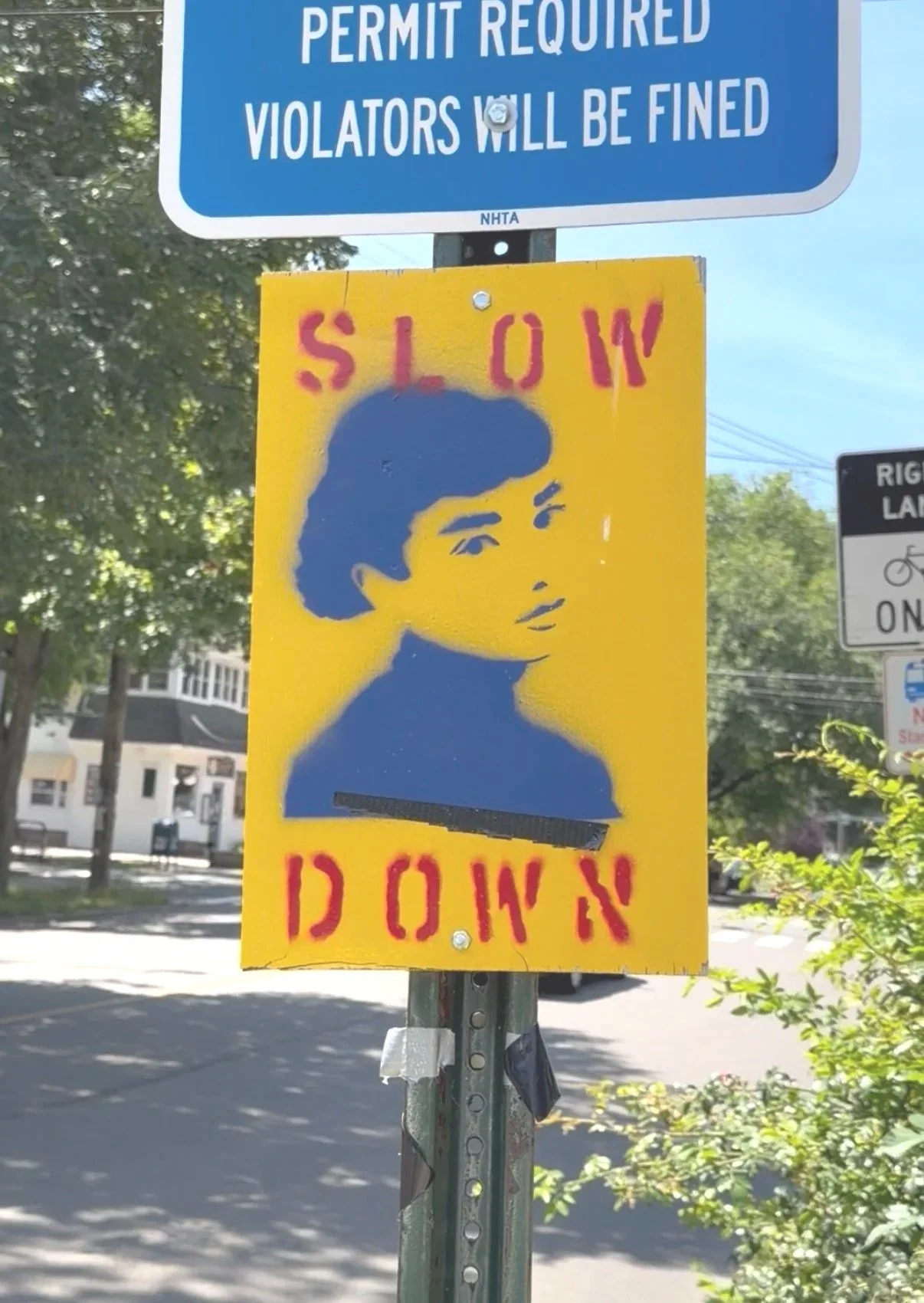
Slow Down sign by Elena’s on Orange in New Haven, CT.
What words have you used besides “slow down?”
I've kept myself from adding “ass clown” to every sign. Or maybe even a sign a little further down the road that says ass clown. Because I'm saying slow down at specific people, people driving fast are assholes, they know they're driving fast. They're just so important, and setting bad examples.
We're passing this down generationally now. Well done, guys. Slow down, ass clown.
There's another series to come out in September that has a different text that’s a different politic, different subject for New Haven.
What are you planning?
A continued project.
Originally Audrey said, say hello. And then just just underneath that, it said “say hello” I was spray painting it on sidewalks in the different leading out the sidewalks, leading out into the different neighborhoods. But it wasn't sticking, it wasn't staying. It was the paint I was using was not adhering.
It would get run over and get worn down really quickly.
Most of these pieces that you see, the more aggressive ones, the heavily layered ones, they've been selected for exhibit in the spring here in New Haven. The Institute Library has a gallery called The Gallery Upstairs, and Martha Willette Lewis has always contacted me and shown pieces of my work there. And now I'm getting a full solo show. I’m very excited.
How long have you been a graffiti artist?
I’ve done it mostly for myself. You know, it's kind of weird. 25 years ago, I did a project that was just called “pervert.” It was a stencil and it was one word and it was just capital letters, Times New Roman: Pervert. People were pronouncing it wrong, they were saying: per-vert, when the project was called “pe-vert.” The verb “to pervert something” doesn't always mean sexual, it means you can take anything to a perversion. I think I perverted bicycles in my life at some points where bicycles were the first and foremost thing in my life, and everything about my life was about bicycles.
That was a while ago. Not anymore. It's still around in places.
And then the one after that was this cat stencil. One night my cat was sitting by a light and her shadow cast up on the wall, and I walked over and traced it, and it was just perfect. It was almost cartoonist, but it was actually authentically her silhouette. And then when she passed, I was going around town just little places off in the corner. There's one by our old bicycle shop where Strangeways is. If you're looking at Strangeways, it's in the bottom left hand corner. It's a yellow one. The rest are white because she was white. I had her for 17 years. Shop cat.
What makes you want to graffiti your art around instead of just keeping it inside?
Hoping to change people. I'd like to think, I know, that these signs have helped people with things they've been dealing with. Because every time I'm out putting one up or fixing one of them, someone always stops me and says, “thank you.” When one fell down the other day in the rain, I went down to get it. And there was a person there, and she's like, you're not taking those away, are you? And I said, “no, no, I'm going to take it back and fix it.” She goes, “oh good.” I've been doing this a long time. My art has always been text driven. From the first time I ever had an exhibit here in New Haven 35 years ago, you know, it was always, always there.
I did a show at a cafe, the Daily Cafe, back in 1990, it was during the AIDS crisis. I did A Day Without Art, where I hung the artwork on the last day of November, hung the artwork in the cafe, and then covered it with black material and put a word on each one that said something of importance when it came to the AIDS crisis.
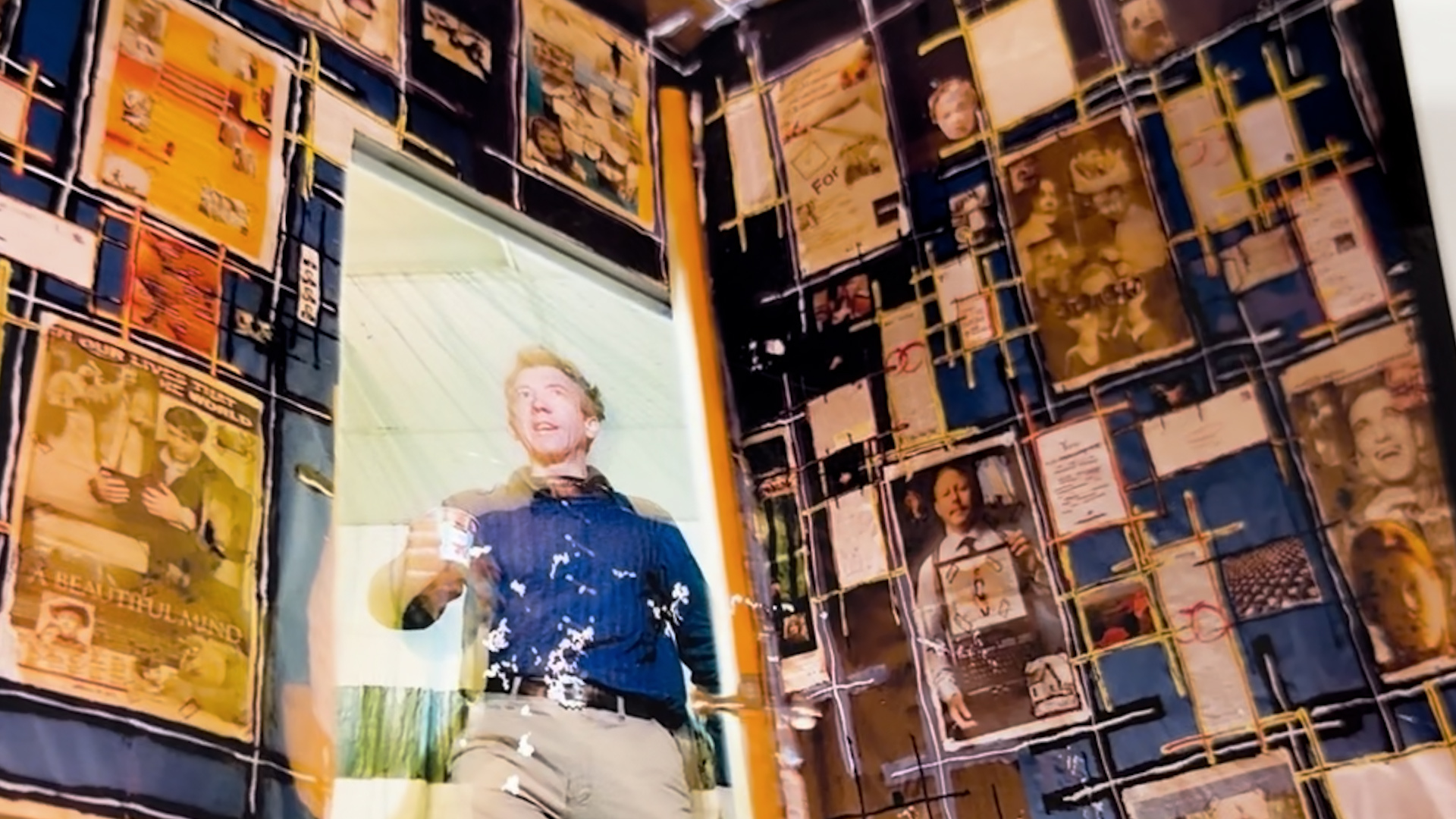
Matthew Feiner featuring collage work in early 2000’s New Haven.
Why Audrey Hepburn?
I grew up sickly. I was always sick. And my mother would bring me home magazines to read: People, Life. So many different magazines back then, and always Audrey Hepburn. My mother loved Audrey, and we would watch Audrey Hepburn movies together. She was just such a kind person. In her personal life, she watches after children. She had a lot to do with the welfare of children throughout the world, throughout her life, until the day she died. Honest person, you know, just as kind as they could get.
But the eyes hold you accountable. The face holds you accountable. They say when you're riding a bicycle that if you're having an interaction with a car, you make sure you look straight at them so that they see your face, which humanizes you, and even better, if they see your eyes, because then they're accountable to you.
What do you usually print on?
I like finding things and painting on them. I like reusing. I get a big kick out of that.
Do you see yourself stopping anytime soon?
No, there's too much going on. You look at the full politics of America right now, and you have to be saying something out loud, because it's some pretty shitty times with some pretty shitty people that aren't being held accountable by the people that we elected to hold them accountable.
Audrey might get really political. Audrey Hepburn survived World War II and her parents were Nazi sympathizers. Yet as a child, she knew four languages. She worked for the resistance as a child. I'm glad she's not around now to see what's going on here in America. Where did we go wrong?
